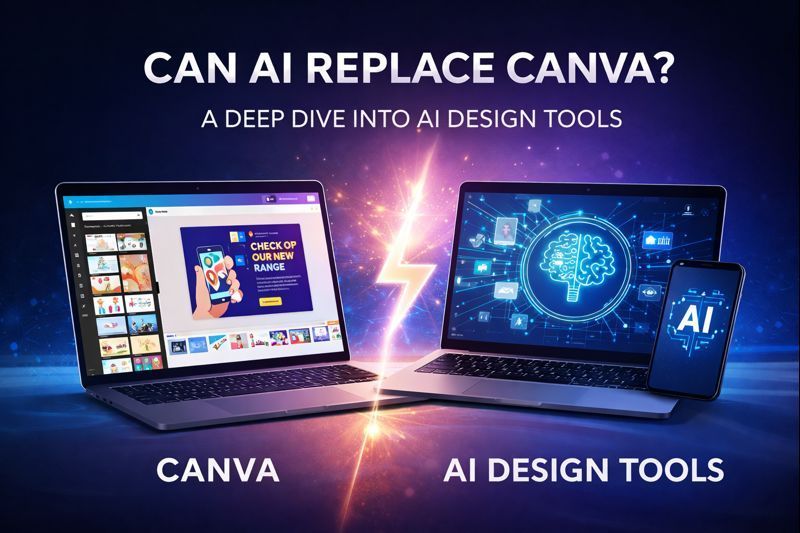
Can AI Replace Canva? A Deep Dive into AI Design Tools
Can AI Replace Canva? A Deep Dive into AI Design Tools
For years, Canva has been the go-to design tool for non-designers. Its drag-and-drop interface, ready-made templates, and ease of use have empowered millions of creators, marketers, and businesses to produce professional visuals without touching Photoshop.
But in 2025, a new question is becoming impossible to ignore:
Can AI design tools actually replace Canva?
With the rise of generative AI platforms like Midjourney, DALL·E, Leonardo.ai, and AI-powered features inside tools like Adobe Firefly and Microsoft Designer, the design landscape is shifting fast. In this deep dive, we’ll explore what Canva does well, what AI design tools can do today, and whether AI is truly ready to replace Canva — or simply redefine how we design.
Why Canva Became So Popular in the First Place
To understand whether AI can replace Canva, it’s important to understand why Canva works so well.
Canva succeeded because it removed complexity. You don’t need design theory, technical skills, or expensive software. Everything is visual, guided, and forgiving. Templates do most of the heavy lifting, while users focus on content rather than layout or typography.
For many users, Canva is not about creativity alone — it’s about speed, consistency, and accessibility. Social media graphics, presentations, flyers, thumbnails, and ads can all be produced quickly without a steep learning curve.
This ease of use is Canva’s biggest strength — and also the benchmark AI tools must meet if they want to replace it.
What AI Design Tools Can Do Today
AI design tools have evolved far beyond simple image generation. In 2025, they can generate complete visuals from a single sentence, adapt styles automatically, and even learn brand identities over time.
Tools like Midjourney and DALL·E excel at creating unique, high-quality images that go far beyond stock photography. Leonardo.ai allows creators to train custom models, making it possible to generate visuals that match a specific brand or artistic style consistently. Adobe Firefly integrates AI directly into professional design workflows, offering text-to-image, generative fills, and style matching.
At their best, these tools don’t just assist design — they generate it.
You can now describe what you want in plain language:
“A modern Instagram post for a tech startup with a blue color palette and minimalist typography,”
and receive a polished visual in seconds.
That level of automation simply didn’t exist a few years ago.
Where AI Outperforms Canva
AI design tools clearly outperform Canva in several key areas.
First, originality. Canva relies heavily on templates, which means designs can start to look familiar. AI-generated visuals are inherently unique, making them ideal for brands that want to stand out visually.
Second, creative exploration. AI can produce dozens of variations instantly, allowing creators to experiment with styles, colors, and layouts at a speed no template-based tool can match.
Third, image generation. Canva offers stock photos and basic AI features, but tools like Midjourney and Leonardo.ai produce cinematic, custom visuals that Canva simply can’t replicate at the same level of detail and realism.
For advanced creators, AI feels less like a design tool and more like a creative collaborator.
Where Canva Still Has the Upper Hand
Despite AI’s rapid progress, Canva still wins in areas that matter deeply to everyday users.
Canva excels at layout control and editing. AI-generated images often need refinement — text alignment, spacing, resizing, brand colors, and export formats still require manual adjustment. Canva makes these tasks intuitive and predictable.
Brand consistency is another major advantage. Canva’s brand kits, reusable templates, and team collaboration features make it easy for businesses to maintain a unified look across all materials — something AI tools are still catching up on.
Most importantly, Canva is low-friction. There’s no prompt engineering, no trial-and-error phrasing, and no uncertainty. You see what you’re building as you build it.
For many users, reliability beats novelty.
Can AI Replace Canva Completely? Not Yet.
The short answer is no — but it’s getting close.
AI design tools are exceptional at creating assets, while Canva is exceptional at assembling and managing designs. Today, AI replaces parts of Canva’s workflow, not the entire experience.
In practice, most creators now use a hybrid approach:
- AI tools generate images, backgrounds, or concepts
- Canva (or similar tools) handle layout, text, resizing, and publishing
This combination delivers both creativity and control.
However, Canva itself is rapidly integrating AI. Features like Magic Design, text-to-image, and AI-powered layout suggestions show that Canva isn’t being replaced — it’s evolving.
The real competition isn’t AI versus Canva.
It’s Canva powered by AI versus standalone AI tools.
What This Means for Creators and Businesses
For creators, the shift means more power and less busywork. You no longer start from a blank canvas or a recycled template — you start from an idea, and AI brings it to life.
For businesses, AI design tools reduce dependency on agencies for simple visuals while opening new creative possibilities for campaigns, branding, and content.
The key skill in 2025 is no longer “design” — it’s creative direction. Knowing what to ask, how to guide AI, and how to refine results matters more than knowing where buttons are.
The Future of Design Is Assisted, Not Replaced
AI isn’t here to eliminate design tools like Canva. It’s here to accelerate creativity and lower barriers.
Canva will continue to dominate structured, brand-focused design. AI tools will continue to dominate originality, speed, and experimentation. Together, they redefine what “design” means for the modern creator.
The smartest creators aren’t choosing sides — they’re learning how to use both.
Want to Stay Ahead of the AI Design Curve?
At ToolTrendAI, we test the latest AI design tools, compare them with platforms like Canva, and break everything down in plain English — no hype, no jargon.
Subscribe to our free newsletter to get weekly deep dives, hands-on tutorials, and early insights into the AI tools that are shaping the future of creativity.
Sign Up For Our Weekly Newsletter and Get Your FREE Ebook " AI For Everyone - Learn the Basics and Embrace the Future"